
Most auto shop owners think a website means they're covered online. That assumption is costing them customers every day. Auto shop digital presence explained properly goes far beyond a single webpage. It includes your Google Business Profile, customer reviews, social media activity, directory listings, and the content you publish. Together, these elements decide whether a driver searching for a brake job at 7pm finds your shop or your competitor. This article breaks down exactly how it works and what you can do about it.
Table of Contents
- Key takeaways
- What digital presence really means for auto shops
- How Google ranking factors impact auto shop visibility
- Practical strategies to build and maintain strong visibility
- Common misconceptions about auto shop online presence
- Measuring success: what metrics to track
- My honest take on digital presence for auto shops
- How Glimmertech helps auto shops get found online
- FAQ
Key takeaways
| Point | Details |
|---|---|
| Digital presence is layered | Your online visibility depends on your Google Business Profile, reviews, website, social media, and citations working together. |
| Review velocity matters most | Recent reviews in the past 90 days carry more ranking weight than a large total count of old reviews. |
| Proximity does not guarantee ranking | A shop farther away with a complete profile and fresh reviews will outrank a closer shop with a weak profile. |
| Content should match how customers search | Pages built around symptoms like "why is my car pulling left" capture high-intent traffic better than generic service pages. |
| Measurement drives improvement | Tracking call clicks, direction requests, and website visits from your Google Business Profile shows you what is actually working. |
What digital presence really means for auto shops
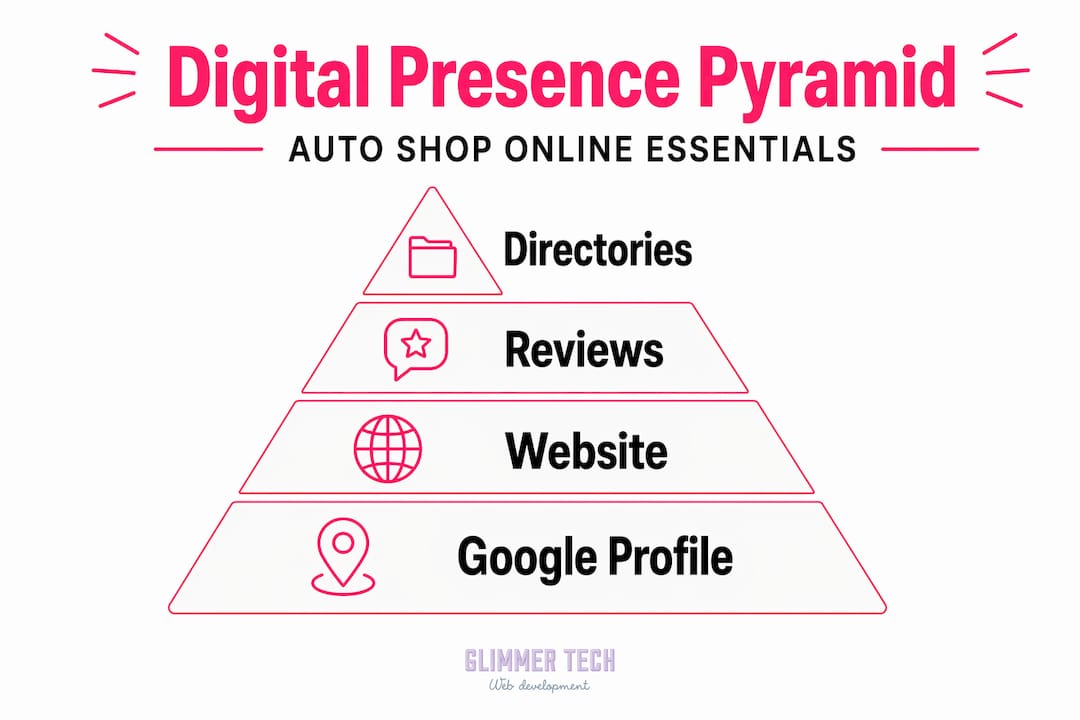
The phrase "digital presence" sounds broad because it is. For an auto shop, it means every place online where a potential customer can find you, form an opinion about you, or decide to contact you. That list is longer than most shop owners realize.
The core components include:
- Google Business Profile (GBP): The panel that appears in Google Maps and local search results with your address, hours, reviews, and photos.
- Your website: Where customers go to verify your services, read about your team, and book appointments.
- Online reviews: Star ratings and written feedback on Google, Yelp, and other platforms that influence both trust and search ranking.
- Social media profiles: Facebook, Instagram, and similar platforms where you build familiarity with your community.
- Citations: Mentions of your business name, address, and phone number (NAP) across directories like Yelp, YellowPages, and AutoMD.
These elements do not operate in isolation. Google's local algorithm uses all of them together to calculate three things: relevance (does your shop match what the person searched for?), proximity (are you near enough to be useful?), and prominence (do other credible sources confirm you are a real, trusted business?). The more consistently your shop shows up across all of these, the stronger your prominence score becomes.
Pro Tip: Match your business description, service names, and hours exactly across every platform. A fully optimized Service Section in your Google Business Profile, aligned with your website's language, reinforces search relevance and confirms your scope of services to Google.
How Google ranking factors impact auto shop visibility
Google's local algorithm is not a mystery. It has three documented factors, but understanding how they interact tells you where to focus your energy.
Relevance is about whether Google thinks your shop matches a given search. If someone types "transmission repair near me" and your GBP does not list transmission services, you are invisible for that query. This is why filling out every service category in your profile matters.
Distance is proximity to the searcher. It influences results but does not control them. Google weighs distance against relevance and prominence rather than using it as an absolute filter.
Prominence is where the real competition happens. This is Google's measure of your credibility online. Reviews, citations, and behavioral signals all feed into it.
Here is how the key ranking factors compare in practical impact:
| Ranking factor | What it includes | Impact level |
|---|---|---|
| GBP optimization | Services, hours, photos, posts, description | Very high |
| Review velocity | Recent reviews in last 90 days | Very high |
| Citation consistency | NAP across directories | High |
| Website relevance | Service pages, location content | High |
| Behavioral signals | Clicks, calls, direction requests | Medium-high |
| Social activity | Posts, engagement, brand mentions | Medium |
GBP signals are the single most important factor in local pack ranking for small businesses. A profile that is incomplete, outdated, or inactive sends a weak signal even if your shop is excellent.
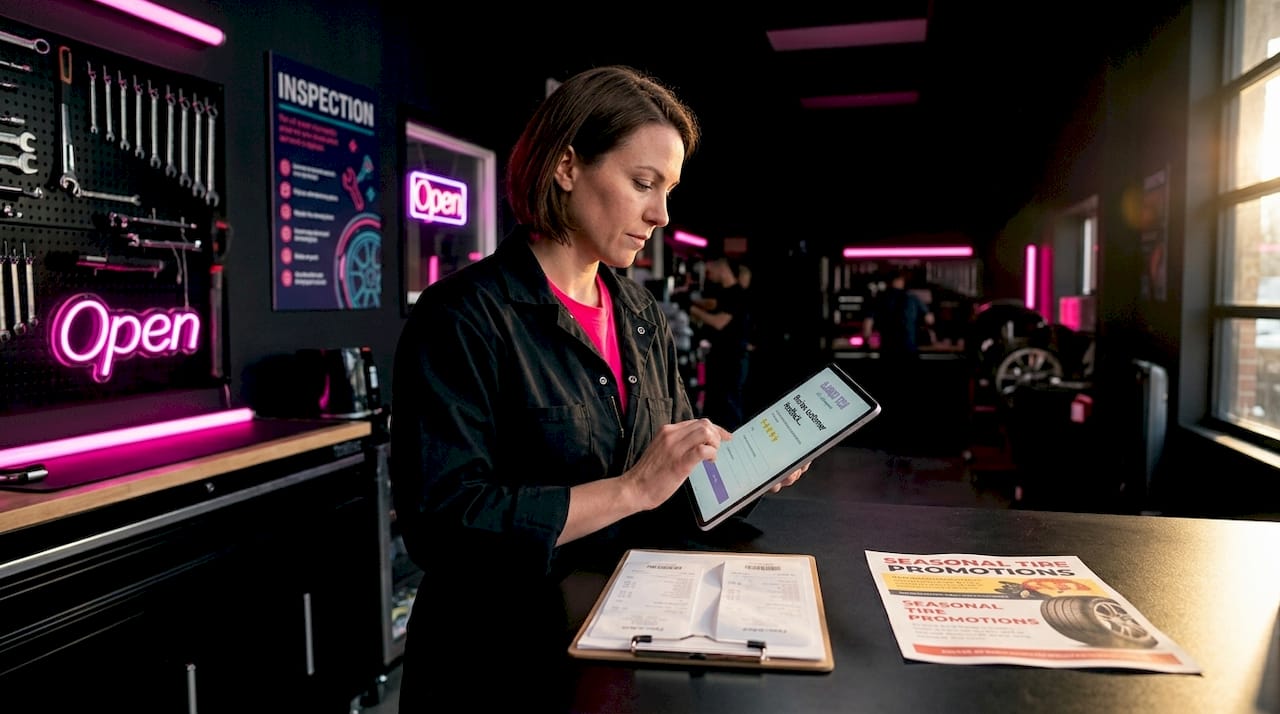
Review recency matters more than most people expect. Profiles with 30 recent reviews in the last 90 days rank higher than shops sitting on hundreds of old reviews. Google treats review velocity as a sign of a living, active business.
Behavioral signals like direction requests and calls from your GBP listing also directly affect your ranking. When searchers click your listing and take action, Google interprets that as confirmation your business is relevant and useful.
Pro Tip: Consistent NAP across directories is a trust signal. Audit your listings on Yelp, YellowPages, and similar sites at least twice a year. Even a small discrepancy in your phone number can reduce your credibility with Google.
Practical strategies to build and maintain strong visibility
Knowing what matters is step one. Putting it into practice is where most shops fall behind. Here is a sequential approach that builds momentum over time.
- Claim and fully complete your Google Business Profile. Add every service category, upload at least 10 photos, write a detailed business description, and set accurate hours including holiday hours.
- Post to your GBP weekly. Consistent posting activity including photos, service updates, and promotional posts signals to Google that your business is active.
- Set up automated review requests. Sending review requests after service visits drives more reviews and improves your monthly acquisition rate. Use a text or email tool that sends the request within an hour of checkout.
- Respond to every review. Yes, every one. Responding to negative reviews shows prospective customers you are professional. Responding to positive ones builds rapport. Both improve your GBP engagement signals.
- Build symptom-based pages on your website. Instead of a generic "brake service" page, write a page titled "Why is my car making a grinding noise when I brake?" These pages capture customers already searching with a problem in hand.
- Audit your citations twice a year. Check that your name, address, and phone number are identical across every directory where your shop is listed.
- Use social media for personality, not just promotions. Before and after photos, quick tips for seasonal maintenance, and short videos of your team at work build familiarity. Customers choose shops they feel they know.
- Implement a referral program. A simple offer like "refer a friend and get $20 off your next visit" costs little and generates high-trust new customers. Promote it via text to your existing customer list.
- Track your numbers monthly. Use your GBP dashboard to monitor call clicks, direction requests, and profile views. Connect these to actual bookings to see which activities move the needle.
Digital marketing treated as a system with consistent branding across all platforms turns searchers into paying customers before they ever walk through your door. Ad hoc efforts rarely compound the way a structured, monthly process does.
Pro Tip: The most common pitfall is optimizing once and walking away. A profile that was complete six months ago but has no new photos, posts, or reviews looks stale to Google. Schedule 30 minutes per week to keep it active.
Common misconceptions about auto shop online presence
A lot of shop owners operate on assumptions about digital marketing that used to be true, or were never true at all. Clearing these up changes how you allocate your time and budget.
- Myth: Being closest means ranking first. A shop 12km away with a complete profile and steady recent reviews can outrank a shop 3km away with a sparse, inactive profile. Proximity is one factor, not the deciding one.
- Myth: Set it and forget it works. A profile you built two years ago and never updated is not helping you. Google rewards ongoing activity.
- Myth: More total reviews is all that matters. Review velocity beats volume. Fifty reviews from this year outperform 300 reviews from three years ago.
- Myth: Social media is optional for auto shops. Auto shop marketing has shifted to a multi-channel system. Social media reinforces brand recognition and drives direct referrals.
- Myth: SEO is only for big businesses. Local SEO specifically benefits small, location-based businesses. 46% of all Google searches have local intent, and most of those searchers are looking for exactly what you offer.
The shops winning in local search right now are not necessarily the largest or the most experienced. They are the most consistently active online, the fastest to collect new reviews, and the most thoughtful about answering the questions their customers are actually typing into Google.
Measuring success: what metrics to track
Improving auto shop online presence is only useful if you know whether it is working. These are the numbers worth watching:
- GBP call clicks: How many people tapped "Call" directly from your Google listing. This is a direct lead count.
- Direction requests: Customers navigating to your shop from Google Maps. High numbers signal strong local visibility.
- Website sessions from organic search: Track this in Google Analytics to see if your SEO content is pulling in traffic.
- Review count and rating trend: Watch for month-over-month growth in review volume and maintain a rating above 4.3.
- Average Repair Order (ARO): A rising ARO alongside increasing traffic often means your digital presence is attracting better-qualified customers.
- Customer Lifetime Value (LTV): Track repeat visits. A strong digital reputation brings customers back, not just once.
Simple dashboards inside your GBP account and Google Analytics show most of this data for free. The goal is not to drown in data. Pick three to five metrics, review them monthly, and tie them back to the activities you changed that month.
My honest take on digital presence for auto shops
I've spent years helping small businesses build websites, and auto shops have a specific challenge that I think gets underplayed. The conventional advice is always "get a website." That is fine as a starting point. But in my experience, the shops struggling with visibility almost never have a website problem. They have a consistency problem.
What I've learned is that a modest website paired with an active GBP, 15 to 20 new reviews per month, and a few symptom-based blog posts will outperform a beautiful website with no recent activity every single time. The shops I see ranking well in 2026 are treating their online presence like a maintenance schedule. They show up, they post something, they ask for a review, they respond to feedback. Every week. It is not glamorous work, but it compounds fast.
I've also noticed that shop owners who invest in their digital presence tend to raise their ARO over time. Customers who found them through a detailed, professional online profile arrive with higher trust and less price resistance. That is not a coincidence. Marketing consistency builds trust before the first phone call ever happens.
If you are just starting out, do not get overwhelmed. Start with your Google Business Profile. Get that right first. Everything else builds on that foundation.
— Annie
How Glimmertech helps auto shops get found online
Building a digital presence from scratch takes time you probably do not have between oil changes and diagnostics. That is where Glimmertech comes in.
Glimmertech builds websites for auto shops that are designed to rank, convert, and grow. Each site is built with location-specific service pages, mobile-first design, and content structured around the questions your customers are already searching. Beyond the website, Glimmertech helps with Google Business Profile setup, citation cleanup, and the foundational digital marketing work that drives real bookings. You do not need to learn SEO. You need a site that works while you work. Visit Glimmertech Digital to see what a strong auto shop web presence actually looks like and to start a conversation about your shop.
FAQ
What is digital presence for an auto shop?
Digital presence for an auto shop includes your Google Business Profile, website, customer reviews, social media profiles, and directory listings. All of these together determine how easily customers can find and trust your shop online.
Why do reviews matter so much for local ranking?
Google treats review velocity as a strong ranking signal. Profiles with recent, frequent reviews rank higher than those with many old reviews, because recency signals an active, trusted business.
Does being the closest shop guarantee top ranking in Google Maps?
No. Google balances proximity with relevance and prominence. A shop farther away with a complete profile and steady reviews will consistently outrank a nearby shop with a weak online presence.
How often should I update my Google Business Profile?
Weekly updates including new photos, posts, and responses to reviews keep your profile active. Consistent posting activity is a documented factor in maintaining and improving your local search ranking.
What is symptom-based SEO content and why does it matter?
Symptom-based content means writing pages that answer specific questions drivers search for, like "why is my steering wheel shaking." These pages attract high-intent traffic and perform particularly well in AI-driven search results in 2026.