
If you think having a website is enough to win work in 2026, you're missing most of the picture. Construction business online presence explained simply means how visible, credible, and findable your firm is across every digital channel where project owners and decision-makers search. 82% of construction buyers research online before they ever pick up the phone. Yet most construction firms still treat their websites like digital business cards and wonder why leads are thin. This article breaks down every layer of online visibility you need, from foundational SEO to AI search, and shows you what actually moves the needle.
Table of Contents
- Key takeaways
- Construction business online presence explained: what it actually means
- Building a website that actually generates leads
- Optimizing your Google Business Profile for real results
- Integrating AI-driven optimization into your digital strategy
- My take on what most construction firms get wrong
- Ready to build a stronger online presence?
- FAQ
Key takeaways
| Point | Details |
|---|---|
| One website is not enough | Real visibility requires SEO, GBP optimization, and AI search presence working together. |
| Service pages drive leads | Each core service needs its own dedicated page targeting one specific buyer intent. |
| GBP is a lead machine | A fully optimized Google Business Profile with reviews and photos directly impacts Local Pack rankings. |
| AI search is here now | Generative Engine Optimization (GEO) is no longer optional for firms that want to appear in AI-generated answers. |
| Consistency wins trust | Matching your business name, address, and service details across all platforms strengthens how AI and Google see you. |
Construction business online presence explained: what it actually means
Digital visibility for construction firms in 2026 is not a single thing. It is a stack of signals that Google, AI tools like ChatGPT, and prospective clients use to decide whether your firm is worth their attention. Most owners think about it as having a website and maybe a Facebook page. That is the floor, not the ceiling.
There are two main visibility systems you need to understand: traditional SEO and Generative Engine Optimization (GEO).
Traditional SEO focuses on ranking in Google search results for specific queries like "commercial concrete contractor Denver" or "industrial steel building construction Texas." The goal is getting your pages in front of buyers who are actively comparing vendors.
GEO is newer and increasingly critical. GEO focuses on becoming a cited source in AI-generated answers. When someone asks ChatGPT or uses Google's AI Overviews to find a contractor, the firms that get mentioned are the ones that structured their content to be citable, authoritative, and semantically clear. Firms investing in SEO and GEO show up more frequently in AI answers and rank higher on Google simultaneously. Ignoring GEO today is the equivalent of ignoring Google SEO in 2010.
The high-intent queries matter most. These are searches from buyers who are close to making a decision: "best design-build firm for warehouses in Phoenix" or "licensed roofing contractor with commercial experience." Capturing these queries requires both systems working together.
- SEO captures buyers who know what they want and are comparing options
- GEO captures buyers who ask open questions to AI assistants and want recommendations
- Local SEO (Google Business Profile) captures buyers ready to call someone today
- Content hubs capture buyers earlier in the research phase
Pro Tip: If you want to know whether you have a GEO problem, type your main service plus city into Google with AI Overviews enabled. If competitors are being cited and you are not, that is your gap.
Building a website that actually generates leads
Lack of clear messaging and poor site structure is one of the biggest reasons construction websites underperform despite having a presence. The fix starts with architecture, not copy.

Think of your website like a job site. Before any work starts, you need a plan. Decide which pages you need before you write a single word. This prevents keyword cannibalization, where two pages accidentally compete for the same search term, and it gives Google a clearer picture of what you offer.
The structure that works best for construction firms looks like this:
- A homepage that covers your firm's overall positioning and links to core services
- A "/services/
directory containing individual pages for each core offering (e.g.,/services/commercial-roofing/,/services/concrete-foundations/`) - Location pages targeting specific cities or regions you serve
- A hub section for educational content that supports, but does not compete with, your service pages
Sites with clear service page architecture see measurable improvements in both SEO rankings and conversion rates. The reason is simple: one intent per page means the buyer finds exactly what they need, and Google knows exactly what the page is about.
Pro Tip: Plan your architecture in a spreadsheet first. List every service, the target keyword for that page, and the URL. Confirm no two pages target the same keyword before you write anything.
Here is a quick comparison of how service pages and hub pages differ in practice:
| Page type | Primary purpose | Content focus | CTA style |
|---|---|---|---|
| Service page | Convert visitors into leads | Specific service details, proof, pricing signals | "Get a quote" or "Call us" |
| Hub page | Build topical authority | Educational overview linking to service pages | "Learn more" or "See our services" |
Prioritizing dedicated pages for core services before expanding blog content captures high-converting, high-intent traffic first. Many construction firms do the opposite. They write blog posts before they have solid service pages, and they wonder why traffic does not convert.
Service-page clarity also benefits AI systems. When your page is unambiguous about what service you provide, where you provide it, and who you serve, AI tools can extract and cite that information far more easily. That is a GEO win as a side effect of simply building a good website.
Optimizing your Google Business Profile for real results
Your Google Business Profile is not a formality. For service-area construction businesses, it is often the most direct path to a phone call today. Here is how to treat it that way.
-
Claim and verify your profile using a dedicated business email. Do not use a personal Gmail account. A business-domain email ties your GBP to your brand identity and makes it easier to manage permissions if your team grows.
-
Choose your primary category carefully. Primary category choice is one of Google's strongest signals for Local Pack ranking and AI Overviews. Do not pick the broadest category. Pick the one that reflects your highest-value service. A commercial roofing firm should select "Roofing Contractor," not "General Contractor."
-
Hide your physical address if you go to your clients. List your service areas instead. Google allows service-area businesses to define the regions they cover. This tells Google where to show you without confusing buyers into thinking they need to visit an office.
-
Fill out the Services tab completely. Add every service you offer with a specific name and a two-to-three sentence description. Mapping your services tab to your highest-value offerings turns your profile from a static listing into a lead-generating asset.
-
Upload at least ten geo-tagged photos. Uploading geo-tagged photos and maintaining a steady review flow correlates with higher Local Pack rankings. Show your completed projects with photos taken on-site. The metadata helps Google associate your business with specific locations.
-
Manage reviews with a strategy. Soliciting reviews that include specific service names and city references improves local ranking and increases the chances that AI snippets pull from your reviews. Ask happy clients to mention the specific service and location in their review. "Great concrete work in Austin" is more useful than "Very professional."
-
Track leads from your GBP. Use a dedicated call tracking number and UTM parameters on your website link so you can see exactly how many leads your profile generates each month.
Pro Tip: Respond to every review, including the negative ones. Google treats active engagement as a signal of a legitimate, active business. It also tells potential clients how you handle problems.
Integrating AI-driven optimization into your digital strategy
GEO is not a replacement for SEO. It is a parallel strategy that becomes more valuable as AI-powered search continues to grow. Here is how it works and what to do about it.
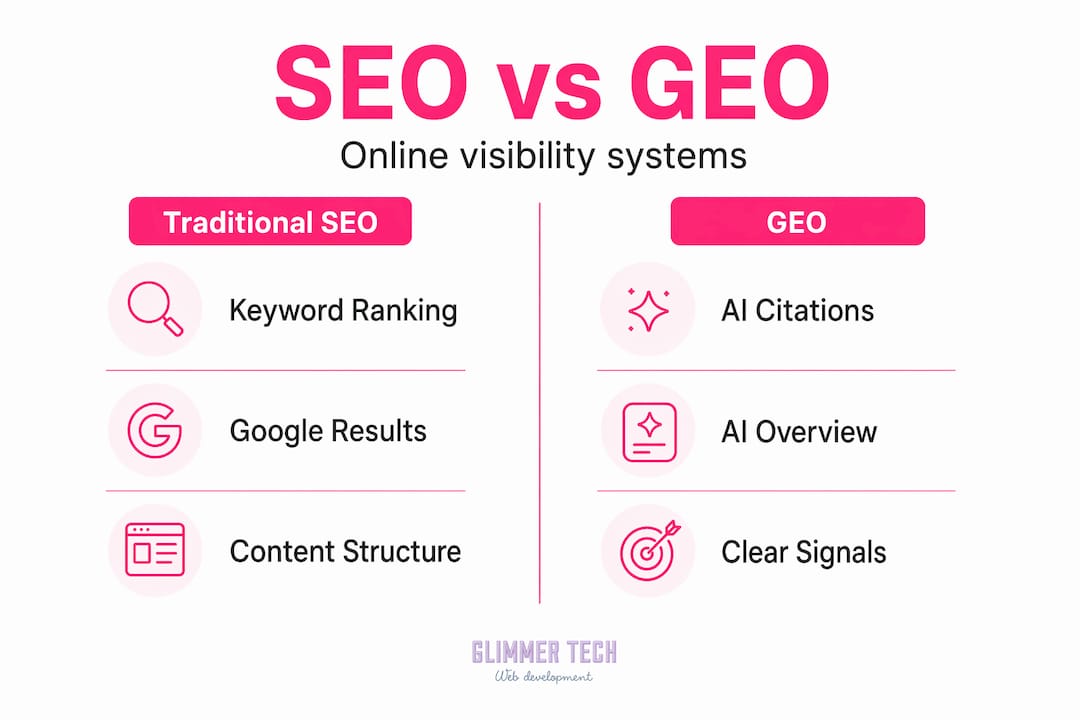
Brand citations in AI responses influence search visibility differently than classical ranking factors. SEO asks: can Google find and rank this page? GEO asks: would an AI system trust this content enough to cite it in an answer?
The tactics that move the needle for GEO in construction marketing include:
- Structured data (schema markup): Add
LocalBusinessandServiceschema to your website so AI crawlers can read your business details cleanly. Consistent NAP and LocalBusiness schema linking your website to your GBP improves visibility in AI features. - Direct claims with evidence: Write service pages that make specific, verifiable statements. "We complete commercial fit-outs within agreed timelines, backed by our 12-year track record" is citable. "We do great work" is not.
- Third-party mentions: Trade association memberships, supplier partnerships, and press coverage all signal authority to AI systems. Link to them and get them linking back.
- Consistent entity data: Your business name, address, phone number, and service descriptions should match exactly across your website, GBP, and every directory listing you appear in.
Here is a practical look at how traditional SEO and GEO tactics compare:
| Factor | Traditional SEO focus | GEO focus |
|---|---|---|
| Content goal | Rank for keywords | Become a citable authority |
| Key signals | Backlinks, on-page optimization | Structured data, direct claims, consistency |
| Primary channel | Google search results | AI-generated answers, AI Overviews |
| Timeline | 3 to 6 months | 4 to 8 months |
On timelines, be realistic. Structured local SEO programs show ranking improvements within 60 to 90 days. GEO results take a bit longer because AI systems update their training and retrieval layers on different schedules. Set expectations accordingly and measure progress monthly.
Pro Tip: Do a "citation audit" quarterly. Search for your business name plus your main service in Google. Check whether the results match the information on your website and GBP. Any mismatch weakens your entity signals for both SEO and GEO.
My take on what most construction firms get wrong
I have seen a lot of construction firms invest in a website and then move on as if the job is done. It is not.
The most common mistake is treating a website like a brochure. It has photos, a services list, and a contact form. That is it. There is no clear hierarchy, no service-specific pages targeting real buyer intent, no structured data, and no connection to what actually happens when a lead calls. The site exists, but it does not work.
What I have found actually works is treating your website as your best salesperson and building accordingly. That means creating a page for every core service, writing copy that speaks directly to the buyer's concern, and connecting your website to your GBP so the two reinforce each other.
The thing most firms ignore entirely right now is AI search readiness. Ignoring it means that when a project manager asks an AI tool "who are the best commercial contractors in [your city]," your name simply will not come up. That is not a hypothetical future problem. It is happening now. Firms that have invested in GEO are already showing up in those answers and getting contacted for bids.
My advice is to stop optimizing for everything at once and focus on depth over breadth. Get your three highest-value service pages built properly. Get your GBP fully optimized. Then expand. The firms that win online are not the ones with the most content. They are the ones with the clearest, most consistent signal about who they are and what they do best.
— Annie
Ready to build a stronger online presence?
Glimmer Tech works directly with construction businesses to build digital presence that generates real leads. From website strategy and redesign to GBP optimization and GEO-ready content architecture, Glimmer Tech handles the technical and strategic work so you can focus on running your firm.
Whether you need a full site build or a focused SEO and GEO strategy, the approach is the same: measurable results tied to your highest-value services. Glimmer Tech brings a 98% client satisfaction rate and a track record of projects that perform. Visit Glimmer Tech to start building a digital presence that actually wins bids.
FAQ
What does online presence mean for a construction business?
Online presence for a construction firm means how easily potential clients can find, evaluate, and contact you through Google search, AI tools, local listings, and your website. It includes your website, Google Business Profile, reviews, and how AI systems cite your business in answers.
How long does construction SEO take to show results?
Most construction firms see measurable ranking improvements within 60 to 90 days of implementing structured local SEO. AI-driven visibility through GEO typically takes four to eight months to become noticeable.
How many service pages does a construction website need?
Each distinct service your firm offers should have its own dedicated page. If you offer commercial roofing, concrete work, and steel erection, those are three separate pages. Combining them reduces clarity for both buyers and search engines.
What is GEO and why does it matter for contractors?
Generative Engine Optimization (GEO) is the practice of structuring content so AI systems like ChatGPT or Google's AI Overviews cite your business in their answers. It matters because more buyers now use AI tools to find and evaluate contractors before they ever run a traditional Google search.
Should a service-area contractor hide their address on Google?
Yes. If you travel to your clients rather than having them visit your location, you should hide your physical address on your Google Business Profile and list your service areas instead. This avoids confusing potential clients and tells Google exactly where you want to appear in local search results.