
Most customers decide where to get their oil changed before they ever leave the driveway. They grab their phone, type "oil change near me," and pick from the first two or three results they see. If your shop does not appear in those results, you are invisible to a large share of potential customers. Understanding why oil change shops need web presence is no longer a theoretical marketing discussion. It is a direct revenue question. This article breaks down how online search drives local decisions, what your website needs to convert those searches, and how to compete with national chains on a local scale.
Table of Contents
- Key takeaways
- Why oil change shops need web presence to win local customers
- What your website and local SEO actually need
- How independent shops can compete with national chains
- Practical steps to build and maintain your web presence
- My take: marketing is not a cost, it is a growth lever
- Get your shop found online with Glimmer Tech
- FAQ
Key takeaways
| Point | Details |
|---|---|
| Customers search before they visit | 80% of consumers research a local business online before stepping through the door. |
| Speed of decision-making is high | Most "near me" searches convert to a physical visit within 24 hours, making local visibility time-sensitive. |
| Your website is your 24/7 front desk | A well-built site captures leads, displays services, and builds trust even when your shop is closed. |
| Local SEO beats generic SEO | Targeting service-plus-location keywords outperforms broad keywords and attracts ready-to-buy customers. |
| National chains are beatable locally | Independent shops that publish detailed, location-specific content can outrank chains for high-intent searches. |
Why oil change shops need web presence to win local customers
When someone's oil light turns on, the decision to find a shop happens fast. That urgency means the customer is not browsing casually. They want a nearby, trustworthy option, and they want it in under a minute. The businesses that show up clearly, with good reviews and an easy-to-navigate website, get the call.
The data backs this up. 80% of consumers research a local business online before visiting. More telling is what happens after the search: 76% of "near me" searches result in a store visit within 24 hours, and 90% of those visitors make a purchase within one week. The conversion rate on local search is exceptionally high compared to most marketing channels.
A website acts as a digital storefront that runs around the clock. Unlike a roadside sign or a Yellow Pages listing, your website can show your current specials, explain your services, display customer reviews, and let someone book an appointment at midnight on a Tuesday. That convenience directly affects whether a potential customer chooses you or the shop down the street.
Your Google Business Profile deserves its own mention here. Fully optimized Google Business Profile listings receive significantly more engagement than incomplete ones, often influencing a customer's choice before they even click through to a website. Getting this profile right, with accurate hours, photos, services listed, and active review responses, is one of the highest-return actions you can take.
Pro Tip: Set up Google Business Profile alerts so you are notified immediately when a new review comes in. Responding within 24 hours signals to both customers and Google that your business is active and attentive.
Here is what local search visibility actually requires:
- A website with dedicated pages for each service you offer
- An optimized, complete Google Business Profile
- Consistent name, address, and phone number across all online directories
- Genuine customer reviews with timely responses
- Mobile-friendly design that loads in under three seconds
Each of these components works together. Missing one weakens the whole system.
What your website and local SEO actually need
Having a website is a start. Having a website that ranks and converts is a different goal entirely. Most oil change shops that do have websites are running generic single-page sites that list their phone number and a rough description of services. That is not enough to compete for local search traffic in 2026.
Service pages that match how customers search
A customer searching for "Nissan oil change Dallas" is much more specific and ready to book than one typing "car maintenance." Pages targeting service, brand, and location keywords outrank generic ones and convert at a higher rate. Your website should have separate pages for different vehicle types, service categories, and geographic areas you serve.
Schema markup, mobile design, and speed
Service Schema markup helps search engines categorize what you offer with precision. Most competitors skip this entirely, which means adding it gives you a technical edge in search results and in local map packs.
Over 70% of near-me searches happen on mobile devices. A site that loads slowly or displays poorly on a phone loses that customer before they read a single word. Page speed and responsive design are not optional features. They are baseline requirements.
Review strategy and trust signals
Authentic reviews, prominently displayed on your site and actively managed on Google, carry real weight. An active and responsive online presence acts as a modern storefront, shaping customer trust before they ever walk in. Include a simple process for asking satisfied customers to leave a review. This is one of the most cost-effective tools in your digital marketing toolkit.
Pro Tip: Add a QR code at your front desk that links directly to your Google review page. Customers who just had a good experience are far more likely to leave a review if the process takes less than 30 seconds.
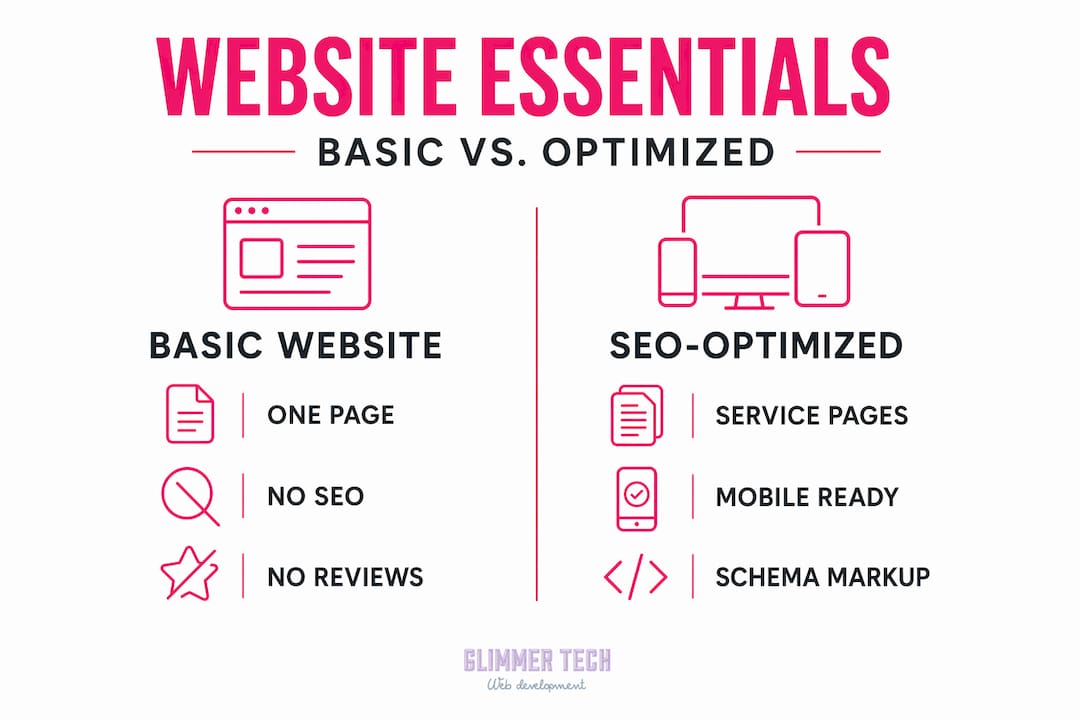
Here is how a basic site compares to an optimized one:
| Feature | Basic website | SEO-optimized website |
|---|---|---|
| Service pages | One general page | Individual pages per service and vehicle type |
| Mobile experience | May not display correctly | Fully responsive, fast-loading design |
| Schema markup | None | Service and local business schema implemented |
| Google Business Profile | Unclaimed or incomplete | Fully optimized with photos, hours, and reviews |
| Local keywords | Generic or absent | Location-plus-service terms throughout |
| Booking option | Phone number only | Online booking or contact form |
How independent shops can compete with national chains
National quick-lube chains have large marketing budgets and teams dedicated to local SEO. They dominate generic "oil change near me" searches using networks of detailed, location-specific pages. That sounds discouraging. The good news is that independent shops have real advantages that chains cannot easily replicate.
Chains compete on volume. You can compete on specificity and trust. A customer searching "oil change for 2021 Ford F-150 near Riverdale" is not looking for a brand. They are looking for someone who knows their truck. Structured service pages with comprehensive content and trust signals outperform generic pages and can even surface your shop in AI-generated search snippets.
Where chains are weak:
- Hyper-local content that reflects neighborhood knowledge
- Personalized customer relationships reflected in detailed reviews
- Flexibility to promote niche services like diesel oil changes or fleet maintenance
- Faster updates when hours or pricing change
Beyond standard oil changes, higher-margin services like synthetic oil upgrades, fluid flushes, and engine treatments offer SEO opportunities with far less competition. A dedicated page for "full synthetic oil change in [your city]" faces a smaller field of competitors than a page for the generic term. That specificity both attracts the right customer and signals expertise to search engines.
Shops that invest in digital marketing gain profitability and customer loyalty by controlling their own demand rather than depending on word-of-mouth or third-party referrals. This is the real strategic value of a web presence. It puts you in control of who finds you and how often.
Pro Tip: Create a page specifically for each city or neighborhood you serve, even if they are close together. A customer five miles away may not search your city name. They will search theirs.
Here is a quick breakdown of where local shops can carve out search territory:
- Brand-specific service pages (e.g., "Honda oil change [city]")
- Service-area landing pages for surrounding neighborhoods
- FAQ content addressing common vehicle service questions
- Blog posts covering seasonal maintenance tips for local conditions
- Fleet or commercial oil change services pages
Practical steps to build and maintain your web presence
Getting started does not require a large budget or technical expertise. It requires a clear plan and consistent follow-through.
- Claim and optimize your Google Business Profile. Fill out every field: services, hours, photos, description, and response to reviews. This is free and has an outsized impact on local rankings.
- Build a clean, mobile-responsive website. You can use a builder or hire a professional. Either way, it must load fast, display correctly on phones, and make it easy for customers to call, book, or get directions.
- Create dedicated service pages. One page per key service, with location and vehicle-type variations where applicable. A well-structured website with local content consistently outperforms a single consolidated page in local search results.
- List your business in local directories. Sites like Yelp, Apple Maps, and local chamber directories all contribute to your overall visibility and signal consistency to Google.
- Build a review acquisition process. Train your service advisors to ask satisfied customers for a review. Send a follow-up text with a direct link. Make it easy, and it becomes routine.
- Publish new content regularly. A monthly post about a seasonal service, a quick tip about oil types, or an update about your hours builds credibility over time. The customer journey spans multiple digital touchpoints, and consistent content keeps your shop present throughout.
- Check your analytics monthly. Look at where traffic comes from, which pages get the most visits, and how many people call or click directions. Adjust your focus based on what is actually working.
Pro Tip: Use a free tool like Google Search Console to see exactly which keywords people use to find your site. You will often discover search terms you had not considered, which can become new service page topics.
Consistency matters more than perfection here. A site updated monthly and a Google profile with weekly photo uploads will outperform a technically perfect site that no one touches.
My take: marketing is not a cost, it is a growth lever
I've spent years watching local service businesses treat their website like a one-time task rather than an ongoing asset. The shop spends two days setting it up, forgets about it for three years, then wonders why the national chain across town is always busier.
What I've learned is that the mindset shift matters as much as the tactics. When you see digital marketing as a direct driver of business growth rather than a line item expense, everything changes. You stop asking "do I need a website?" and start asking "how do I make my website work harder?"
I've also seen shops underestimate reviews. One bad review with no response does more damage than most owners realize. Conversely, a shop with 80 honest four and five-star reviews and a professional-looking site will beat a competitor with better equipment and no online presence, almost every time.
The other pitfall I see constantly is neglecting local SEO in favor of social media. Social is useful for retention and brand familiarity. But it does not replace the intent-driven traffic that comes from someone searching for your exact service right now. Invest in both, but do not let social distract you from the foundation. If you are considering a full rebuild of your digital presence, understanding what a website redesign involves before you start will save you time and money.
The shops that grow steadily are the ones that treat their web presence like they treat their equipment: maintained, updated, and essential to the operation.
— Annie
Get your shop found online with Glimmer Tech
Building a web presence that actually attracts local customers takes more than a template website. It takes the right structure, the right keywords, and design that turns visitors into booked appointments.
Glimmer Tech builds websites specifically designed for local service businesses like yours, with mobile-first design, fast load times, and on-page SEO built in from the start. The team handles everything from page structure and local keyword targeting to Google Business Profile strategy, so you can focus on running your shop. With a 98% client satisfaction rate and a track record of measurable results, Glimmer Tech delivers sites that do real work. See what is possible for your oil change shop today.
FAQ
Why does an oil change shop need a website?
A website makes your shop visible to the 80% of customers who research local businesses online before visiting. Without one, you lose those customers to competitors who do show up in search results.
What is the most important thing for local search rankings?
A fully optimized Google Business Profile combined with a website that has dedicated, location-specific service pages gives your shop the strongest foundation for ranking in local search results.
Can a small shop compete with national oil change chains online?
Yes. Independent shops can outrank chains for specific, high-intent searches by publishing detailed, vehicle-specific, and location-targeted content that chains cannot replicate at scale.
How long does it take to see results from local SEO?
Most shops see measurable improvements in search visibility within three to six months of consistent effort, including optimized pages, regular content updates, and active review management.
Do reviews really affect search rankings?
Reviews are a confirmed ranking factor for local search. Shops with more recent, positive reviews and active responses consistently rank higher and earn more clicks than those with outdated or sparse review profiles.