
A construction website is a dedicated online platform built to showcase your projects, services, and credentials to attract and convert clients. In the construction industry, this type of site is also called a contractor website or trade business website. Unlike a generic small business site, a construction website centers on visual proof of work, trust signals, and local lead generation. Tools like Wix and Webflow now make it faster than ever to build one. The right site can be your most productive sales tool, working around the clock to bring in qualified inquiries.
What is a construction website and why does it matter?
A construction website is a purpose-built digital presence that markets your trade business to local clients searching for contractors online. Your construction site online presence is often the first impression a potential client gets before they ever call you. That first impression carries real weight. Clients who find you online are already in buying mode, which makes your site a direct lead generation asset, not just a digital brochure.
The construction industry is a relationship-driven field, but those relationships now start online. A well-built contractor website tells clients who you are, what you build, where you work, and why they should trust you. Without that, you are invisible to a large share of your local market.
What are the essential features of a construction website?
The most effective construction websites share a clear set of features that work together to build trust and drive inquiries.
- Project portfolio: Visual project portfolios are the most persuasive element for potential clients. Use real photos, videos, or drone footage from completed jobs. Never substitute stock images for actual work.
- Service pages: Detailed service pages help clients quickly decide whether you match their needs. Each page should name the service, describe your process, and include a call to action.
- Trust signals: Licenses, certifications, and testimonials tied to real project outcomes lower the perceived risk of hiring you. Place these throughout the site, not just on a single "About" page.
- Contact options: Visible contact details including email, phone, physical address, and an inquiry form increase the chance a visitor takes the next step.
- Mobile-friendly design: Mobile optimization and page speed are non-negotiable. A slow or broken mobile experience sends visitors straight to a competitor.
- Clear calls to action: Every page should direct visitors toward a specific goal, whether that is requesting a quote, calling your office, or viewing your portfolio.
- Local SEO targeting: Your site should include your city, county, and service area in page titles, headings, and content to rank in local searches.
Pro Tip: Add a dedicated "Recent Projects" page and update it every 60–90 days. Fresh portfolio content signals to both clients and search engines that your business is active.
How does a construction website differ from a general business website?
A construction website is built around proof of work, not product descriptions or service lists alone. This distinction shapes every design and content decision.
General business websites often rely on text-heavy pages, stock photography, and broad messaging. Construction websites require a different approach for four specific reasons:
- Clients buy with their eyes. A homeowner hiring a remodeler or a developer choosing a general contractor wants to see finished work before they commit. Authentic project stories and team expertise outperform stock visuals and standard text every time.
- Trust signals are industry-specific. A software company lists client logos. A construction company lists contractor licenses, insurance certificates, and trade association memberships. These details matter to clients in ways that generic "About Us" copy does not.
- Navigation must be project-driven. Time-strapped clients want to find your work and your phone number fast. Simplified navigation that prioritizes service selection and contact paths significantly improves lead generation on construction sites.
- Leads come from local search. A general business website might target a national audience. A construction website targets a specific geographic area, which requires local SEO built into the site architecture from day one.
"Construction is a people business. Including team profiles and named testimonials tied to real outcomes greatly reduces client risk perception." — Crucible
This quote captures the core difference. General websites sell products or services. Construction websites sell people and proven results.
What are best practices for designing a construction website?
Strong construction website design follows a set of proven practices that balance visual appeal with technical performance.
Choose the right building tool. Platforms like Wix and Webflow offer construction-specific templates that reduce build time. AI web design technologies now allow building a basic site in under five minutes. That speed is useful for getting online fast, but a professional build adds the customization that sets you apart.
Prioritize page speed and mobile performance. A site that loads slowly on a phone loses visitors before they see a single project photo. Follow mobile optimization best practices to keep load times under three seconds on all devices.
Update your portfolio and testimonials regularly. Ongoing maintenance leads to better client trust and measurable SEO benefits. A portfolio frozen in 2022 signals a business that may not be active.
Apply local SEO basics. Target your city and service area in page titles, meta descriptions, and body content. Learn the SEO basics for 2026 to rank ahead of competitors in your local market.
Build for accessibility. A site that works for users with visual or motor impairments reaches a wider audience and meets legal standards in many states. Follow accessibility best practices to cover the essentials.
Here is a quick comparison of DIY versus professional construction website builds:
| Factor | DIY Builder (Wix, Webflow) | Professional Build |
|---|---|---|
| Cost | $500–$2,000 | $2,000–$50,000 |
| Time to launch | Days to weeks | Weeks to months |
| Customization | Moderate | High |
| SEO setup | Basic | Advanced |
| Ongoing support | Self-managed | Agency or developer |
Pro Tip: Use inquiry-focused navigation that puts your "Get a Quote" button in the top right corner of every page. That single change can lift contact form submissions noticeably.
How can a small construction business start building its website?
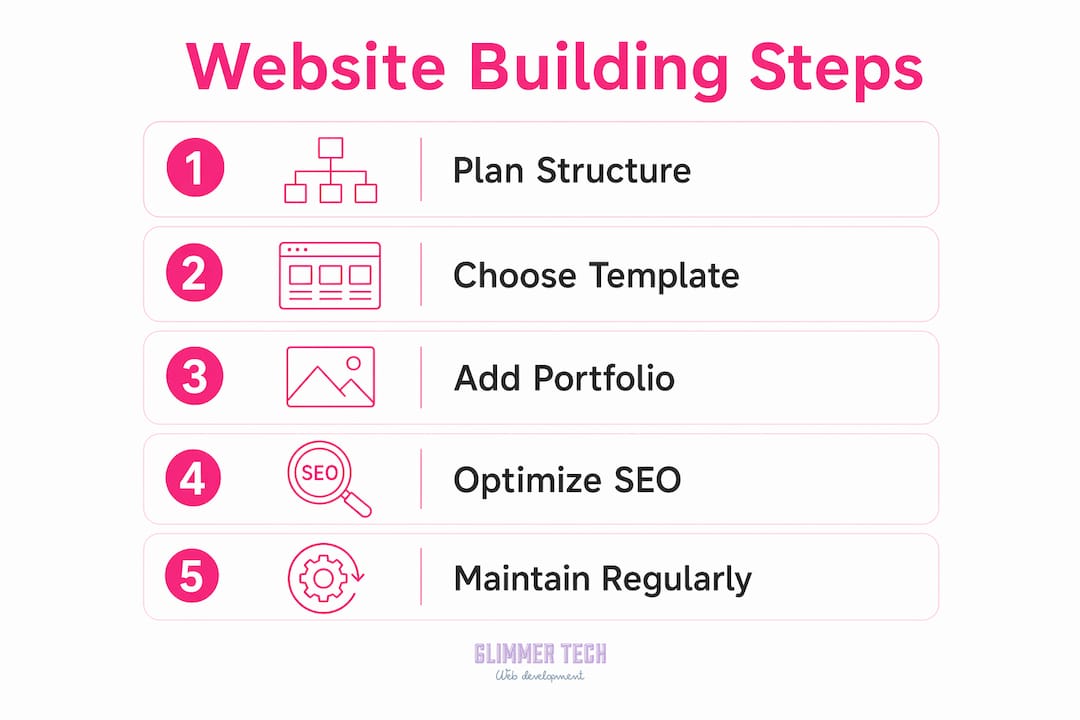
Building a contractor website does not require technical expertise. Follow these steps to go from zero to a live site.
- Choose a platform. Select a website builder like Wix or Webflow for a DIY approach, or hire a web design agency for a custom build. Contractor website costs range from $500 for templates to $50,000 for custom agency builds. Most small construction businesses find the $2,000–$10,000 range effective.
- Register a domain name. Choose a domain that includes your business name or your trade and city. For example, "smithplumbingdenver.com" is clear and locally targeted.
- Plan your site structure. Map out your core pages before you build. A standard construction website includes Home, Services, Portfolio, About, and Contact.
- Gather your content. Collect high-quality photos of completed projects, write brief descriptions of each service, and compile two to three client testimonials with real names and project details.
- Select a template or design. Pick a template built for construction or trade businesses. Avoid generic layouts that do not support portfolio galleries or service breakdowns.
- Test on mobile and desktop. Before you launch, load every page on a phone, a tablet, and a desktop browser. Fix any layout or speed issues you find.
- Launch and promote. Submit your site to Google Search Console, claim your Google Business Profile, and share your new URL on your social media accounts and email signature.
Each step builds on the last. Skipping site structure planning is the most common mistake small business owners make. A clear plan before you build saves hours of rework later.
Key takeaways
A construction website is the single most effective tool a small contractor has for generating local leads and building client trust online.
| Point | Details |
|---|---|
| Core definition | A construction website is a specialized platform built to showcase projects, services, and credentials to attract local clients. |
| Must-have features | Include a real project portfolio, service pages, trust signals, contact options, and mobile-friendly design. |
| Key differentiator | Construction sites rely on authentic project evidence and local SEO, not generic content or stock photos. |
| Best practices | Update your portfolio regularly, prioritize page speed, and use inquiry-focused navigation to drive leads. |
| Getting started | Budget $2,000–$10,000 for an effective small business build and follow a seven-step launch process. |
What small construction businesses get wrong about their websites
I have reviewed hundreds of contractor websites over the years, and the same mistakes appear again and again. The biggest one is treating the website as a one-time task. Owners build a site, launch it, and then leave it untouched for three years. By then, the portfolio is outdated, the testimonials are stale, and the site ranks nowhere in local search.
The second mistake is hiding the people. Construction is a trust business. Clients want to know who will show up at their property. A team page with real names, photos, and brief bios does more for conversion than any design feature. Named testimonials tied to specific projects do the same. Generic five-star reviews without context carry almost no weight.
The third mistake is building for looks instead of leads. A visually impressive site that buries the phone number or makes it hard to request a quote fails at its primary job. Every design decision should serve the goal of getting a visitor to make contact.
My honest view is that a modest, well-maintained site with real project photos and a clear contact path will outperform an expensive, visually complex site with no fresh content. Start simple. Stay consistent. Update it.
— Annie
Build your construction website with glimmer tech
Glimmer Tech builds websites for small construction businesses that need more than a template. Every site is designed to show your work clearly, load fast on any device, and turn visitors into inquiries.
Glimmer Tech's team handles design, development, and SEO setup so you can focus on running your business. With a 98% client satisfaction rate and a track record of successful projects, the process is direct and the results are measurable. If you are ready to build or improve your contractor website, see what Glimmer Tech offers and take the first step toward a stronger online presence.
FAQ
What is a construction website used for?
A construction website is used to showcase completed projects, list services, build client trust, and generate local leads. It acts as a 24/7 sales tool for your contracting business.
How much does a construction website cost?
Contractor website costs range from $500 for basic templates to $50,000 for custom agency builds. Most small construction businesses find the $2,000–$10,000 range delivers strong results.
What features should a construction website include?
A construction website should include a real project portfolio, detailed service pages, trust signals like licenses and testimonials, clear contact options, and a mobile-friendly design.
How is a construction website different from a regular business website?
A construction website focuses on visual project evidence, local SEO, and industry-specific trust signals. General business websites rely more on text and broad messaging, which is less effective for contractors.
Can i build a construction website without coding experience?
Yes. Platforms like Wix and Webflow offer construction-specific templates that require no coding. AI-powered tools can produce a basic site in under five minutes, though a professional build adds more customization and SEO depth.