

Construction website SEO in 2026 is defined by four non-negotiable pillars: local authority signals, Interaction to Next Paint (INP) performance, structured data accuracy, and Answer Engine Optimization (AEO). These are not optional upgrades. They are the baseline requirements for any contractor or builder who wants to rank above competitors in local search and appear in AI-generated answers. This guide covers each pillar with specific tactics you can apply directly to your site, whether you run a solo operation or manage marketing for a regional construction firm.
What are the key SEO ranking factors for construction websites in 2026?
Search engine optimization for construction websites in 2026 centers on demonstrating expertise, earning local trust, and delivering fast, responsive user experiences. Google's ranking systems now evaluate content quality, business legitimacy, and technical performance simultaneously. Passing on any one of these dimensions costs you rankings.
The foundational ranking signals for construction sites break down as follows:
- Service clarity. Every page should name specific services and the geographic areas you serve. "General contractor serving Denver, CO" outperforms "we do it all" every time.
- Google Business Profile (GBP) optimization. Your GBP listing is your most powerful local ranking asset. Fill out every field, add project photos weekly, and post updates at least once per week.
- NAP consistency. Your Name, Address, and Phone number must match exactly across your website, GBP, and every directory listing. Formatting variations like "123 Main St" versus "123 Main Street" are treated as different listings by Google. That inconsistency splits your local authority.
- Customer reviews. Volume, recency, and the detail within reviews all influence local pack rankings. A review that mentions "bathroom remodel in Austin" carries more weight than a generic five-star rating.
- Core Web Vitals. Google measures page experience through metrics including Largest Contentful Paint (LCP), Cumulative Layout Shift (CLS), and INP. All three must pass thresholds for your site to compete at the top of results.
- Content demonstrating expertise. Project case studies, before-and-after galleries, and detailed service pages signal to both Google and AI systems that your business is a credible authority in your trade.
Pro Tip: Build a dedicated page for each service category you offer, such as "commercial roofing," "foundation repair," or "kitchen remodeling." Each page should target a specific keyword and include a real project example from your portfolio.
Your construction business online presence depends on these signals working together. Ranking well in 2026 is not about gaming algorithms. It is about giving Google and AI systems accurate, specific, and consistent information about who you are and what you do.

How can construction businesses optimize website speed and INP?
Interaction to Next Paint (INP) replaced First Input Delay (FID) as a Core Web Vital in 2024, and it remains the most technically demanding metric for construction websites to pass in 2026. INP measures the full latency of every user interaction on a page, from click to visual response. The target score is 200 milliseconds or less. Sites that exceed 500ms are rated "poor" and face ranking penalties.
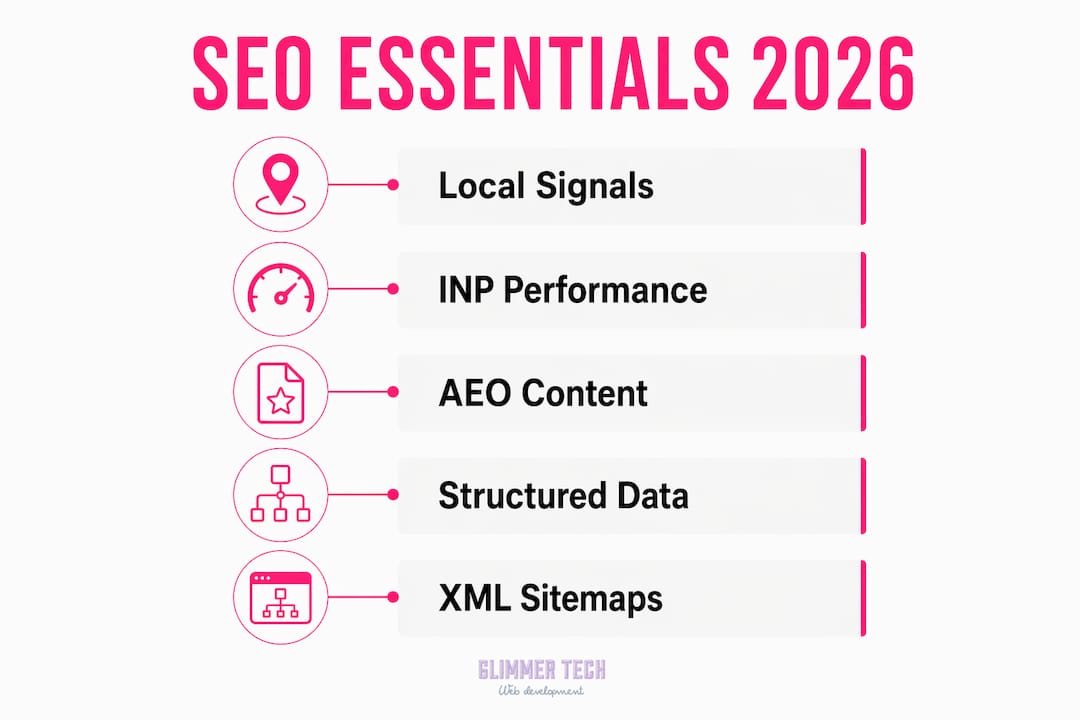
The gap between FID and INP performance is significant. Only 65% of origins currently pass the INP threshold at the 75th percentile, compared to 93% that passed the old FID metric. That means roughly one in three websites fails a metric Google actively uses to rank pages. Construction sites with heavy project galleries, contact forms, and embedded maps are especially vulnerable.
Here is how to diagnose and fix INP issues systematically:
- Measure first. Use Chrome DevTools' Performance panel or the web-vitals JavaScript library to record real interactions. You need to identify which specific clicks or taps trigger long delays before you can fix anything.
- Break up long tasks. Any JavaScript task running longer than 50ms on the main thread blocks user interactions. Use code splitting to divide large scripts into smaller chunks that load on demand.
- Reduce JavaScript bundle size. Every 100KB of JavaScript removed saves roughly 50ms of main thread time on a mid-range mobile device. Audit your scripts and remove unused libraries.
- Defer non-critical scripts. Load analytics, chat widgets, and marketing pixels after the page becomes interactive. Use the "defer
orasync` attribute on script tags wherever possible. - Handle third-party embeds carefully. Third-party scripts like embedded videos, maps, or review widgets frequently cause poor INP by blocking the main thread. Replace them with facades that load the full embed only when a user clicks.
- Trim DOM size. Large DOM trees with thousands of nodes slow down rendering and increase interaction latency. Aim for fewer than 1,500 total DOM nodes per page.
"INP is more reflective of real-world performance than traditional FID, emphasizing total latency rather than initial delay only." — WebVitals.tools
A website redesign focused on Core Web Vitals can deliver measurable ranking improvements within weeks of deployment. For construction sites with large image galleries, image optimization is also a direct lever for improving both LCP and INP scores.
What are the best local SEO and AEO tactics for construction websites?
Local SEO for construction businesses in 2026 operates on two tracks: traditional local signals that influence Google Maps and local pack rankings, and Answer Engine Optimization (AEO) that positions your business as the direct answer in AI-generated search results. Both tracks require the same underlying asset: specific, accurate, and consistent business data across every digital touchpoint.
Google Business Profile tactics that move rankings:
- Select the most specific service categories available. Choosing categories like "Bathroom Remodeler" or "Roofing Contractor" improves how AI systems understand and recommend your business compared to generic categories like "Contractor."
- Upload new project photos weekly. GBP listings with active photo uploads consistently outperform static profiles in local pack rankings.
- Post weekly updates about completed projects, seasonal promotions, or service reminders. These posts signal to Google that your listing is actively managed.
- Respond to every review within 48 hours. Your response text is indexed and contributes to your keyword relevance in local search.
NAP citation management:
Maintain identical NAP formatting across your website, GBP, Yelp, Houzz, Angi, HomeAdvisor, and any industry-specific directories. Use a citation management tool to audit and correct inconsistencies quarterly. Even minor formatting differences fragment your local authority.
Answer Engine Optimization for contractors:
AEO is the practice of structuring your content to become the direct, authoritative answer to customer queries in AI-powered search tools like ChatGPT, Perplexity, and Google's AI Overviews. AI-referred traffic converts at roughly four to five times the rate of traditional organic search for home service businesses. That conversion premium makes AEO one of the highest-return investments in your 2026 marketing budget.
To build AEO authority, create dedicated FAQ sections on each service page that answer the exact questions your customers ask. "How long does a roof replacement take in Phoenix?" is more valuable than a generic paragraph about roofing timelines. AI systems demand consistent, specific, and quality data across all digital touchpoints. Your website content, GBP data, and directory listings must all tell the same story.
Pro Tip: Ask satisfied customers to mention the specific service and city in their review. A review reading "excellent foundation repair in Columbus" gives Google and AI systems a direct keyword signal tied to your location.
Why are XML sitemaps and structured data critical for construction SEO?
XML sitemaps and structured data markup are the two technical tools that tell search engines exactly what your site contains and how it connects to your real-world business. For construction companies with multiple service areas or dozens of project pages, these tools are not optional. They are the difference between Google discovering your content in days versus months.
| Element | Purpose | Best Practice |
|---|---|---|
| XML sitemap | Guides crawlers to all indexable pages | Use a dynamic sitemap that updates automatically when new pages are published |
| HTML sitemap | Helps users navigate large sites | Include for sites with 50+ pages; link from the footer |
| LocalBusiness schema | Ties your website to your GBP location | Use JSON-LD format with matching NAP per location |
| robots.txt | Controls crawler access | Never block URLs that appear in your sitemap |
| Canonical tags | Prevents duplicate content issues | Set canonical URLs on all location and service pages |
Dynamic XML sitemaps that automatically update on content changes accelerate Google's discovery and indexing process significantly. Static sitemaps go stale and create indexing delays. If your site runs on WordPress, plugins like Yoast SEO or Rank Math generate dynamic sitemaps automatically. For custom-built sites, your developer should configure sitemap generation at the framework level.
One common mistake: including priority and changefreq tags in your sitemap. Google ignores these tags entirely, and leaving them out reduces file size without any negative impact on indexing. Keep your sitemap lean and accurate.
LocalBusiness schema markup connecting your website pages to specific GBP locations strengthens Google's knowledge graph association with your business. For a construction company serving three cities, each location page should carry its own JSON-LD block with the address, phone number, and service area matching that city's GBP listing exactly. Understanding what website indexing means for your business is the first step toward using sitemaps and schema effectively.
Avoid creating near-duplicate city pages that swap only the city name in otherwise identical content. Google classifies these as doorway pages and suppresses them in rankings. Each location page needs a unique project showcase, local team information, or area-specific service detail that makes it genuinely different from every other page on your site.
Key takeaways
Construction website SEO in 2026 requires passing INP performance thresholds, maintaining exact NAP consistency, optimizing Google Business Profile with specific categories, and structuring content for AI-driven answer engines.
| Point | Details |
|---|---|
| INP is the critical speed metric | Target 200ms or less; only 65% of sites currently pass this threshold. |
| NAP consistency drives local rankings | Exact formatting across all directories is the strongest local ranking signal. |
| Specific GBP categories boost AI visibility | Categories like "Roofing Contractor" outperform generic labels in AI recommendations. |
| AEO converts at 4-5x organic rates | Structure FAQ content to answer exact customer questions for AI-driven traffic. |
| Dynamic sitemaps speed up indexing | Auto-updating sitemaps reduce crawl delays for multi-location construction sites. |
What I've learned about SEO priorities for construction businesses in 2026
The single biggest mistake I see construction companies make is treating location pages as a copy-paste exercise. Swap the city name, change a sentence or two, and publish. Google has become very good at identifying this pattern, and the penalty is real. Pages that should rank for "kitchen remodeler in Sacramento" simply disappear from results because they offer nothing a user in Sacramento could not find on the Denver version of the same page.
The construction businesses that are winning in local search right now are the ones publishing actual project stories. Photos from the job site, the specific challenge the homeowner faced, the materials used, the timeline. That kind of content cannot be faked or duplicated. It signals expertise to Google and builds trust with the homeowner reading it before they call.
On the technical side, INP is the metric most construction site owners have never heard of, and it is the one most likely to be holding their rankings back. A site that looks great but takes 600ms to respond to a button click is failing a Core Web Vital. That failure is visible to Google and invisible to the business owner until rankings drop.
My honest recommendation: fix INP before you write another blog post. Then build your AEO content strategy. The contractors who adopt these practices early will hold a significant advantage over competitors still focused on keyword density and backlink counts.
— Annie
How Glimmer Tech helps construction businesses rank in 2026
Glimmer Tech builds websites for construction businesses that are designed to perform from day one. That means fast load times, passing Core Web Vitals scores including INP, and site architecture built for local SEO from the ground up. Every project includes structured data implementation, dynamic sitemap configuration, and Google Business Profile alignment so your site and your listing work as a single, coherent signal to search engines.
If your current site is losing ground to competitors in local search, or if you have never had a technical SEO audit, Glimmer Tech offers a direct path forward. Visit Glimmer Tech's web services to see how the team approaches construction industry SEO and to start a conversation about your specific goals.
FAQ
What is INP and why does it matter for construction websites?
INP stands for Interaction to Next Paint. It measures how quickly your website responds to every user click or tap, with a passing score of 200 milliseconds or less. Construction sites with heavy galleries and embedded maps frequently fail this metric, which directly affects Google rankings.
How do I optimize my Google Business Profile for local SEO?
Select specific service categories like "Roofing Contractor" rather than generic ones, upload new project photos weekly, post updates regularly, and respond to every review within 48 hours. These actions signal to Google that your listing is active and authoritative.
What is Answer Engine Optimization for contractors?
AEO is the practice of structuring website content to appear as the direct answer in AI-powered search tools like ChatGPT and Google's AI Overviews. AI-referred traffic converts at four to five times the rate of traditional organic search for home service businesses, making AEO a high-priority strategy in 2026.
Why should I use LocalBusiness schema on my construction website?
LocalBusiness schema markup in JSON-LD format connects your website pages to your Google Business Profile locations, strengthening Google's knowledge graph association with your business. Each location page should carry its own schema block with NAP data that matches the corresponding GBP listing exactly.
How often should I update my XML sitemap?
Use a dynamic sitemap that updates automatically whenever you publish new pages or update existing ones. Static sitemaps go stale and delay Google's discovery of new content, which is a significant disadvantage for construction sites that regularly add project pages or service area pages.