
A website is the single most important sales and education tool an electric vehicle shop can own. 65% of car buyers are interested in EVs, yet only 8% actually purchase one. That 57-point gap exists almost entirely because buyers cannot find reliable, clear answers to their questions. Your website closes that gap. Shops that educate customers online convert at three times the rate of those that do not. The website is not a digital brochure. It is the foundation of your entire sales operation, connecting digital research to in-store decisions and functioning as what the industry calls an omnichannel customer experience center.
Why electric vehicle shops need websites to close the education gap
The knowledge barrier is the defining challenge in EV retail right now. Buyers want to go electric. They hesitate because they cannot get straight answers on range, charging costs, home installation, or federal incentives. Most of them will not call your shop to ask. They will search, land on a competitor's page, and make up their minds before you ever know they existed.
A website built around customer education changes that dynamic completely. Comprehensive, searchable content covering real-world range, charging infrastructure, total cost of ownership, and available tax credits gives buyers the confidence to move forward. This is not about publishing a FAQ page. It is about building a resource that answers every question a hesitant buyer has before they think to ask it.
Interactive self-service tools are where education becomes conversion. Websites with tools like TCO calculators, charging time simulators, and trade-in estimators see higher visitor engagement and longer session times than sites without them. A buyer who spends 12 minutes running numbers on a charging cost calculator is not browsing. They are qualifying themselves.
- Range and charging explainers specific to the models you sell, not generic industry copy
- Total cost of ownership calculators that factor in local electricity rates and state incentives
- Charging infrastructure maps showing nearby public stations and home installation options
- Incentive guides updated for the current federal and state tax credit landscape
- Trade-in and financing tools that let buyers estimate their real out-of-pocket cost
Pro Tip: Build a dedicated "Is an EV right for me?" page that walks visitors through their daily commute distance, home charging options, and budget. This single page can pre-qualify leads better than any sales call.
How AI and digital merchandising tools increase EV website conversions
Static pages and generic chatbots fail EV buyers. A buyer asking "Will a Tesla Model Y handle my 180-mile round trip to the mountains in winter?" needs a specific, contextual answer. A scripted chatbot that routes them to a contact form loses that lead permanently.

AI sales agents trained on real buyer conversations handle exactly these questions. They provide context-aware responses about range in cold weather, charging stop planning, and cost comparisons between models. The results are measurable. Average automotive website conversions sit at 2 to 3 percent. AI-powered sites have reached conversion rates as high as 13%, roughly five times the industry baseline. That is not a marginal improvement. It is a structural change in how your website performs.
Here is how AI agents create that lift in practice:
- 24/7 lead capture — AI agents engage visitors at 11 PM on a Sunday when your staff is unavailable, capturing contact details and buyer intent data that your CRM can act on Monday morning.
- Personalized range and cost answers — Instead of directing buyers to a spec sheet, the agent walks them through their specific use case and recommends the right model.
- Objection handling at scale — Common concerns like charging anxiety, battery degradation, and resale value get addressed instantly, without a salesperson needing to be present.
- Lead qualification data — Every conversation the AI has reveals buyer anxieties and preferences, giving your sales team context before the first human interaction.
"The successful EV dealer is both a technology company and customer experience center, with the website central to the integrated sales journey." — 2026 Dealership Guide to EVs
Digital merchandising extends this idea to your listings themselves. Transparent EV listings that answer key buyer questions upfront, without requiring a sales call, reduce bounce rates and build trust before any human contact occurs. Adding "best for" usage labels to listings, such as "ideal for daily commuters under 60 miles" or "built for road trip capability," helps buyers self-qualify and arrive at your door already confident in their choice. You can learn more about which page types convert best for shops in this segment.
What website features every EV shop must have
The features that separate high-converting EV shop websites from average ones are specific and well-documented. EV shoppers expect detailed, transparent information on range, charging, costs, and incentives as a baseline. Anything less and they leave.
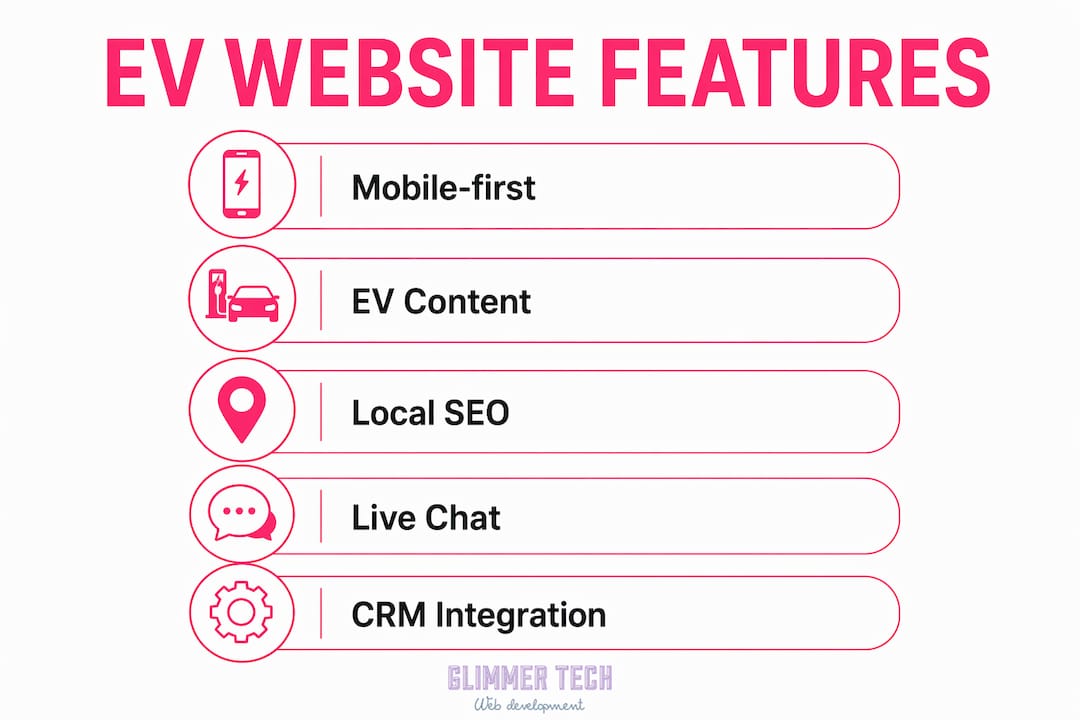
Mobile-first design and speed
Best-performing EV sites prioritize clean design, fast load times, and mobile optimization above everything else. More than half of automotive research happens on mobile devices. A site that loads slowly or breaks on a phone loses buyers before they read a single word.
EV-specific content pages
Generic auto dealer pages do not work for EV retail. You need dedicated pages for each model's real-world range, home charging setup guides, a breakdown of federal and state incentives, and a financing page that accounts for EV-specific loan products. Each page should be written for a buyer who knows nothing about EVs and is slightly skeptical.
Local SEO for high-intent searches
Local SEO-optimized EV pages capture buyers at the moment they are ready to act. Searches like "EV dealer near me" or "Tesla service center in [city]" carry high purchase intent. Your pages need to include your city and region naturally, reference nearby charging infrastructure, and feature local incentive programs. A Google Business Profile connected to a well-structured local page is one of the highest-ROI investments an EV shop can make.
Live chat and CRM integration
Live chat connected to a CRM system means no lead goes untracked. When a buyer asks a question at 2 AM, that conversation becomes a lead record with context. Your sales team follows up with information, not a cold introduction. Glimmer Tech's guide on adding live chat to auto shop sites covers the practical setup in detail.
| Feature | Impact on conversion |
|---|---|
| TCO and charging calculators | Increases session time and self-qualification rate |
| AI sales agent | Lifts conversion from ~2.5% to as high as 13% |
| Local SEO pages | Captures high-intent regional search traffic |
| Mobile-optimized design | Retains buyers who research on smartphones |
| Transparent listings with usage labels | Reduces bounce rate and builds pre-visit trust |
Pro Tip: Create a "Your first EV" landing page targeting first-time buyers specifically. This segment has the highest anxiety and the highest potential. A page that speaks directly to their concerns converts at a disproportionately high rate.
Common challenges EV shops face when building and maintaining a website
Launching a website is one challenge. Keeping it accurate and effective in a market that changes as fast as EV technology is another.
- Outdated incentive information is one of the most common trust killers. Federal and state EV tax credits change frequently. A page showing an expired $7,500 credit that no longer applies damages credibility immediately. Build a content review schedule into your operations, not just your launch plan.
- Content overload is a real risk. EV buyers need education, but a page with 3,000 words of dense technical copy drives people away. Prioritize scannable formats: short paragraphs, headers, bullet points, and visual tools over walls of text.
- Site speed degradation happens as you add tools, images, and integrations. Test your load speed monthly using Google PageSpeed Insights. A one-second delay in page load time reduces conversions measurably.
- Omnichannel consistency matters more than most shop owners realize. If your website shows a price or incentive that your sales floor cannot honor, you lose the buyer's trust at the worst possible moment. Your digital and physical experience need to match. The omnichannel sales approach treats the website as an integrated part of the in-store experience, not a separate channel.
- Data privacy and compliance requires a brief but serious note. If you collect buyer data through forms, chat tools, or AI agents, you need a clear privacy policy and compliance with applicable state laws. This is not optional, and it is not complex to address upfront.
The auto shop website launch guide from Glimmer Tech covers the technical and content setup process in detail for shops starting from scratch.
Key takeaways
EV shops that invest in education-first websites with AI tools and local SEO convert buyers at significantly higher rates than those relying on static pages or no web presence at all.
| Point | Details |
|---|---|
| Education gap is the core problem | 65% of buyers are interested in EVs but only 8% buy. Websites that educate close this gap. |
| AI agents multiply conversions | AI-powered sites reach 13% conversion versus the 2-3% industry average. |
| Local SEO captures ready buyers | Optimized local pages target high-intent searches at the moment buyers are ready to act. |
| Interactive tools drive engagement | TCO calculators, charging simulators, and trade-in tools increase session time and self-qualification. |
| Omnichannel consistency builds trust | Website content must align with in-store pricing and offers to avoid losing buyers at the final step. |
Why EV shops without websites will fall behind in 2026
I have watched enough small business owners treat their website as a one-time project to know exactly what happens next. The site goes live, looks decent, and then sits untouched for two years while the market moves. In EV retail, two years is an eternity.
Buyers in 2026 do not walk into a dealership uninformed. They arrive having already read reviews, compared range specs, run cost calculations, and formed opinions about which model fits their life. If your website was not part of that research process, you were not part of their consideration set. You simply did not exist.
What I find most underappreciated is the compounding advantage of early digital investment. Shops that built strong educational content and local SEO presence two years ago are now ranking for searches their competitors are only beginning to target. The gap between digitally active EV shops and passive ones is widening, not narrowing.
The shops I see winning are not the ones with the biggest inventory. They are the ones whose websites function as active sales tools, with AI agents handling inquiries, calculators engaging buyers, and local pages capturing search traffic. They treat their digital presence as a core business asset, not an afterthought.
My honest advice: do not build a website and walk away. Build one that works while you sleep.
— Annie
How Glimmer Tech can build your EV shop's website
Glimmer Tech builds websites for auto and EV shops that are designed to convert, not just look good.

Every site Glimmer Tech delivers includes mobile-first design, local SEO architecture, and the technical foundation needed to integrate AI sales agents and lead capture tools. The team understands EV buyer psychology and builds content structures that address the education gap from the first page load. With a 98% client satisfaction rate and a track record of measurable results, Glimmer Tech gives EV shop owners a website that actively grows their business. Explore web design services built specifically for shops that want to turn online traffic into real customers.
FAQ
Why do EV shops need a website more than traditional auto shops?
EV buyers face a steeper knowledge curve than traditional car buyers, covering range, charging, incentives, and total cost of ownership. A website that addresses these questions directly is the primary tool for converting interested buyers into customers.
What is the biggest conversion mistake EV shop websites make?
The most common mistake is treating the website as a static catalog rather than an active sales tool. Sites without interactive tools, AI agents, or educational content see conversion rates of 2 to 3 percent. Sites with these features reach up to 13 percent.
How does local SEO help an EV shop's website?
Local SEO-optimized pages capture buyers searching for EV dealers or service centers in their area at the exact moment they are ready to act. Including regional charging details, local incentives, and test-drive booking on these pages increases both visibility and lead quality.
How often should an EV shop update its website content?
Incentive information should be reviewed monthly, since federal and state EV tax credits change frequently. Model-specific range and pricing pages should be updated whenever manufacturer specs or inventory changes occur.
Can a small EV repair shop benefit from a website?
Yes. The benefits of online presence for EV repair shops include capturing local search traffic, building credibility with EV owners who are actively looking for qualified technicians, and reducing the volume of basic inquiry calls by answering common questions online.