
Website conversion is defined as the moment a visitor on your site completes a specific action that matters to your business, such as making a purchase, submitting a contact form, or signing up for a newsletter. The industry term for measuring this is conversion rate optimization (CRO), and it is one of the most direct ways to connect your website traffic to real revenue. Tools like Google Analytics, Shopify, and HubSpot all track these actions because they reveal how well your site actually works. Understanding what does website conversion mean gives you a clear picture of whether your site is earning its place in your marketing strategy.
What does website conversion mean and how is it calculated?
Website conversion rate is calculated using a simple formula: (number of conversions ÷ total visitors) × 100. The result is a percentage that tells you how many visitors took the action you wanted. If 50 people bought something from your online store out of 2,000 visitors, your conversion rate is 2.5%.

Before you calculate anything, you need to define what counts as a conversion for your business. A purchase is obvious, but a completed contact form or a phone call click can be just as valuable depending on your model. Tracking the wrong action gives you a number that looks meaningful but tells you nothing useful.
Session-based vs. visitor-based rates
There are two ways to measure conversion rate, and the difference matters. Session-based rates measure how often a conversion happens per visit. Visitor-based rates measure how often a unique person converts over time. Session-based rates are easier to pull from most analytics platforms, but visitor-based rates give you a clearer picture of how well your site acquires actual customers.
For a small business running repeat promotions or email campaigns, visitor-based measurement is the smarter long-term choice. It removes the distortion caused by the same person visiting your site three times before buying.
Industry benchmarks you should know
Average e-commerce conversion rates sit between 2.35% and 2.58%, but the top 10% of sites exceed 11%. That is a fivefold gap, and it exists entirely because of optimization decisions. The average B2B website converts at roughly 2.23%, while top B2B performers reach 11.70%.
These numbers tell you that average is not a ceiling. They also tell you that most small business websites have significant room to grow without spending more on ads.
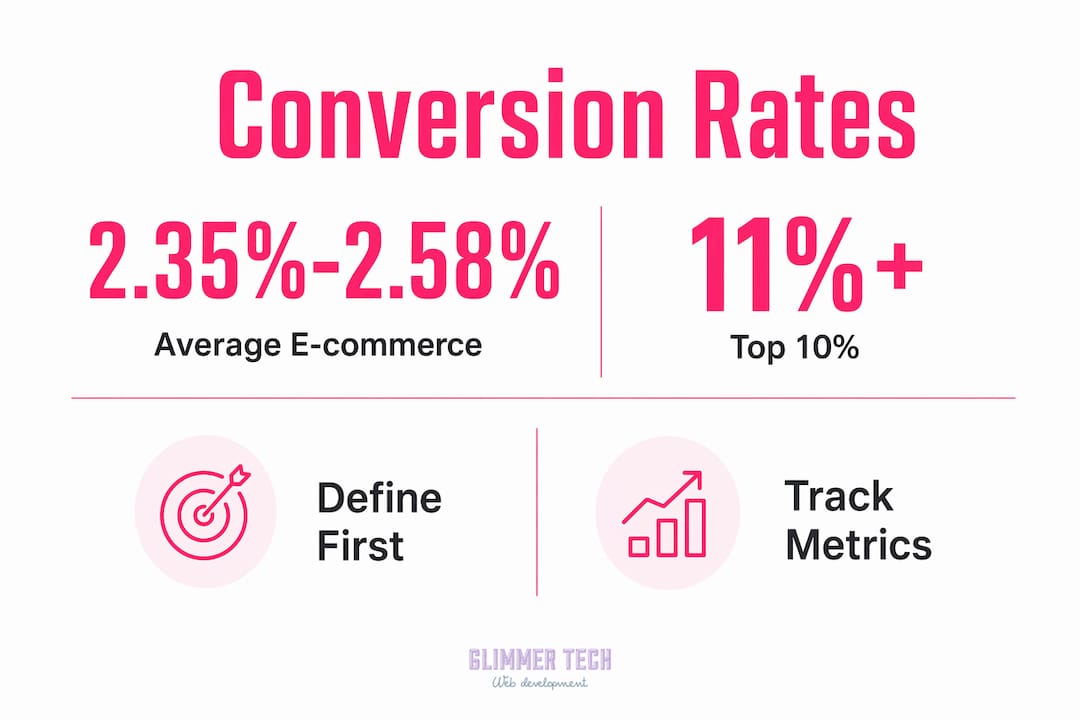
| Industry | Average conversion rate | Top 10% performers |
|---|---|---|
| E-commerce | 2.35%–2.58% | 11%+ |
| B2B websites | 2.23% | 11.70% |
| Lead generation | 2%–5% | 10%+ |
Pro Tip: Set your conversion rate baseline in Google Analytics before running any optimization tests. You cannot improve what you have not measured.
What types of conversions should small businesses track?
Conversion definitions depend on your business model and where a visitor sits in your sales funnel. An e-commerce store tracks purchases. A service business tracks contact form submissions. A SaaS company tracks free trial sign-ups. Each of these is a valid conversion, and each tells a different story about your site's performance.
Macro conversions vs. micro conversions
Macro conversions are the primary goals: a completed sale, a booked appointment, a submitted quote request. Micro conversions are smaller signals of intent: a newsletter signup, a product page view, a video play, or a PDF download. Both matter.
Micro conversions are especially useful for small businesses with longer sales cycles. A visitor who downloads your pricing guide is not a customer yet, but they are much closer than someone who bounced after five seconds. Tracking micro conversions lets you see where people are in the buying process and where they drop off.
Here are the most common conversion types by business category:
- E-commerce: Completed purchases, add-to-cart actions, wishlist additions
- Service businesses: Contact form completions, phone call clicks, appointment bookings
- B2B companies: Demo requests, whitepaper downloads, webinar registrations
- Content and media sites: Email list sign-ups, account creations, comment submissions
- Local businesses: Direction requests, click-to-call actions, review submissions
Pro Tip: Track at least one macro conversion and two micro conversions in Google Analytics. The micro conversions will show you exactly where visitors lose interest before reaching your main goal.
What affects website conversion rates?
Several factors directly influence whether a visitor converts or leaves. Understanding them helps you prioritize where to focus your time and budget.
-
Page load speed. Slow pages kill conversions before visitors even see your offer. Image optimization alone can cut load times significantly on most small business sites.
-
Mobile experience. More than half of web traffic now comes from mobile devices. A site that works beautifully on desktop but breaks on a phone loses those visitors entirely. Mobile optimization is not optional in 2026.
-
Traffic quality and offer alignment. Sending the wrong audience to your page is one of the most common and expensive mistakes. A high click-through rate with a low conversion rate usually means your ads are over-promising or reaching the wrong people. A low click-through rate with a high conversion rate means your audience is well-qualified but your offer needs stronger visibility.
-
Call-to-action clarity. Vague CTAs like "Learn More" underperform against specific ones like "Get Your Free Quote Today." The visitor should never have to guess what happens when they click.
-
Website navigation and structure. Confusing menus and buried pages create friction. Navigation design directly affects how quickly visitors find what they need and whether they stay long enough to convert.
-
Vanity metrics vs. value metrics. A rising conversion rate looks good, but pair it with average order value (AOV) and customer lifetime value (CLV). A site converting at 5% with a $10 average order is less valuable than one converting at 2% with a $200 average order.
Understanding the difference between click-through rate and conversion rate is critical. CTR measures ad or link engagement. Conversion rate measures what happens after the click. Misinterpreting these two metrics leads to campaigns that look successful on paper but generate no real revenue.
How to improve website conversions: practical strategies
Optimizing landing pages, simplifying forms, improving mobile experience, and using analytics tools are the four pillars of conversion improvement for small businesses. Each one addresses a specific point of friction in the visitor journey.
-
Build focused landing pages. Each campaign or traffic source should land on a page built for one specific conversion. A page trying to do five things at once usually accomplishes none of them well.
-
Run A/B tests on key elements. Test one variable at a time: headline, CTA button color, form length, or hero image. Tools like Google Optimize and VWO make this accessible without a developer.
-
Simplify your forms. Every extra field you add to a form reduces completions. Ask only for what you need to take the next step. For most small businesses, a name and email address is enough to start a conversation.
-
Improve your mobile experience. Check your site on three different phone models. If buttons are hard to tap, text is too small, or the checkout process requires pinching and zooming, you are losing mobile conversions daily.
-
Use conversion tracking in Google Analytics or a platform like Hotjar. Heatmaps show you exactly where visitors click, scroll, and stop. Session recordings reveal friction points you would never find by looking at aggregate data alone.
-
Optimize your calls to action. Place your primary CTA above the fold, repeat it at logical decision points, and make the benefit explicit. "Start Your Free Trial" outperforms "Submit" every time.
Pro Tip: Start with your highest-traffic page that is not converting well. One improvement there will have more impact than ten changes on pages nobody visits.
Converting website visitors into paying customers is a repeatable process once you understand the levers. The goal is not a perfect site. The goal is a site that gets measurably better each month.
Key takeaways
Website conversion rate is the single most direct measure of how well your site turns traffic into business outcomes, and improving it costs less than buying more traffic.
| Point | Details |
|---|---|
| Define conversions first | Decide what action counts as a conversion before measuring anything. |
| Use the right formula | Divide conversions by total visitors, then multiply by 100 for your rate. |
| Know your benchmarks | Average e-commerce rates sit at 2.35%–2.58%; top performers exceed 11%. |
| Track micro conversions | Smaller actions like downloads reveal where visitors drop off before converting. |
| Fix friction before buying traffic | Improving page speed, mobile UX, and CTAs costs less than increasing ad spend. |
Why conversion rate is the metric I keep coming back to
I have worked with enough small business owners to know the pattern. They spend months building a website, launch it, drive traffic with ads, and then wonder why the phone is not ringing. The site looks great. The traffic numbers are decent. But nothing is converting.
The uncomfortable truth is that most small business websites are built to look good, not to perform. Design and conversion are not the same thing. A beautiful homepage with no clear CTA is just an expensive brochure.
CRO is considered the north star metric for digital marketing because it extracts more value from the visitors you already have. That matters enormously for small businesses with limited ad budgets. You do not always need more traffic. You often need to do more with the traffic you already have.
One thing I see small business owners get wrong consistently is chasing session-based conversion rates when visitor-based rates would tell them so much more. If someone visits your site four times before booking a call, a session-based rate counts that as four sessions and one conversion. A visitor-based rate counts it as one person who converted. The second number is the one that actually reflects how well your site builds trust over time.
My honest advice: pick two or three conversions that directly connect to revenue, track them every week, and run one test per month. That discipline, applied consistently over a year, will outperform any one-time website redesign.
— Annie
How Glimmer Tech helps small businesses convert more visitors
Small business owners who want a site that actually performs need more than good design. They need a site built around conversion from the ground up.

Glimmer Tech builds websites that combine bold design with measurable results. Every project includes conversion-oriented structure, mobile optimization, and integration with analytics tools so you can track what matters from day one. With a 98% client satisfaction rate and a track record of successful projects, Glimmer Tech delivers sites that do not just look professional. They generate leads, bookings, and sales. If you are ready to turn your website into your best-performing sales tool, explore Glimmer Tech's web services and see what a conversion-focused build looks like.
FAQ
What does website conversion mean in simple terms?
Website conversion means a visitor on your site completes a specific action you want them to take, such as buying a product, filling out a contact form, or signing up for an email list.
What is a good website conversion rate for a small business?
The average e-commerce conversion rate is 2.35%–2.58%, but top-performing sites exceed 11%. For most small businesses, a rate above 3% is a strong starting point worth building on.
How is conversion rate different from click-through rate?
Click-through rate measures how often people click a link or ad. Conversion rate measures what happens after the click, specifically whether visitors complete the desired action on your site.
What is the easiest way to improve website conversion?
Simplify your forms, clarify your call-to-action, and check your site on mobile devices. These three changes address the most common friction points without requiring a full redesign.
Why does visitor-based conversion rate matter more than session-based?
Visitor-based conversion rates measure how often a unique person converts over time, giving a clearer picture of customer acquisition efficiency than session-based rates, which count repeat visits as separate events.